

Join us on


Please visit the Sitemap to see the full range of information on this site
MountainWalk.co.uk is produced by Trish Haill Associates Copyright
Have you climbed Ben Nevis, Snowdon or Scafell Pike? Or taken part in the Three Peaks Challenge? Or have a special walk you'd like to share? We'd love to here from you! Join us on Facebook or Send us an email.
Snowdon - Facts and History
Snowdon History
Snowdon, in Welsh, is Yr Wyddfa, which means tomb or monument. Legend has it that it is the tomb of Rhita Gawr, an ogre who would kill kings and make cloaks out of their beards. He supposedly met his end when King Arthur climbed to the top of Mount Snowdon and killed him.
No one knows who first conquered Snowdon, but ascents of the mountain became popular when Thomas Pennant published 'Tours' in 1781 and included his visit to the summit.
Mount Snowdon, as indeed the surrounding area, has been mined since the Bronze Age, and evidence of copper mining can be seen all over the mountain, from old mine buildings, to old tramways. Care should be taken around these old buildings.
Mount Snowdon, as indeed the surrounding area, has been mined since the Bronze Age, and evidence of copper mining can be seen all over the mountain, from old mine buildings, to old tramways. Care should be taken around these old buildings.
Facts and Figures of Snowdon
Snowdon stands 1,085 metres (3,560 feet) high. Each year 350,000 people reach the summit, some on foot and some by train. The summit has 200 inches(508 cm) of rain per year, and can reach temparatures of 30 centigrade in high summer, and plummet to - 20 centigrade in the winter. Add to this winds of up to 150 mph and the temparature can feel more like - 50. The summit buildings at the top can by covered by ice and snow between November and April.
Snowdon Mountain Railway
Before the railway, ponies used to take tourists to the summit of Snowdon. Sir Richard Moon and Mr George Assheton Smith were responsible for the idea of the Snowdon Railway - Sir Moon as a way of boosting tourists using his standard guage lines, and Mr Smith as he realised that tourist cash may compensate him from the loss of income from his declining mines.
They imported a fully working 800mm guage mountain railway from Switzerland. The railway remains the only rack and pinion railway in the UK. It has tooted racks in the centre of the track that engage with cogs under the carriages.
The only accident on the railway occurred on the day it opened to the public in 1896. Engine #1, Ladas, derailed and plummeted down a slope. The crew jumped from the engine and survived, and the guard applied the hand brake to the carriages and brought them to a halt. Unfortunately, one of the passengers panicked and jumped from the carriage, falling onto the tracks and under the wheels. He later died from his injuries. The saga wasn't quite over, as just as the carriages stopped, the engine following behind (Enid - still operating today) hit them from behind!
The railway was closed. Since it reopened the following year there have been no further accidents!
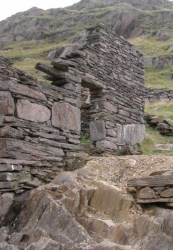
Example of old mine buildings to be found around Snowden
And since that date there has never been another Engine #1 on the Snowdon Railway!
The cost of the train trip is not cheap (apart from being a good walk in itself, another reason for trying to make the summit on foot!), but is a great way for those who cannot make the climb to travel to the top. However, good weather cannot be guaranteed, and you may start the trip on a clear day, only to find yourself in cloud as you reach the top.
The pictures below were taken at the start and end of one train's journey up the mountain on the same day!
The cost of the train trip is not cheap (apart from being a good walk in itself, another reason for trying to make the summit on foot!), but is a great way for those who cannot make the climb to travel to the top. However, good weather cannot be guaranteed, and you may start the trip on a clear day, only to find yourself in cloud as you reach the top.
The pictures below were taken at the start and end of one train's journey up the mountain on the same day!
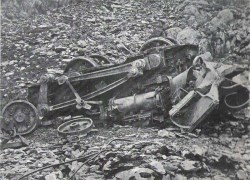
Picture of 'Ladas' after the crash from Volume 1 of Trains in Trouble by Arthur Trevena (SIF - Truro)
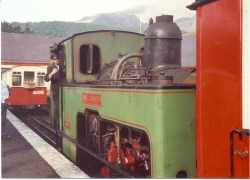
Noel Siabod at Llanberis station
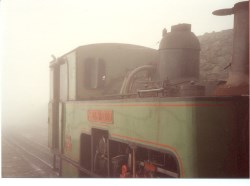
Noel Siabod at the old Summit Station in thick mist
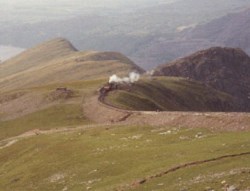
If you choose to take the train up Mount Snowdon, you can walk back down via the Llanberis Path. You can get some wonderful views of the trains puffing their way up and down from the path. Not all trains are steam - there are also diesel engines.
Train puffing up Snowdon
If you plan to take the train up to the top of Snowdon beware that the trains get very crowded in the summer, and it is best to arrive early or even more advisable to book in advance by ringing 0870 458 0033 at least the day before. If you don't you may have a long wait. A board by the ticket office will tell you which is the next train with available seats. You can buy a return, or a single to the top. Single tickets for the journey down are sold on standby basis only.
Weather permitting the trains run from mid May to the end of October right to the summit, but from mid March, and a little way into November, stop at Clogwyn. Trains start running at 9am and continue until late afternoon. There may be discounts available if you choose an early train.
Buildings on Snowdon Summit
In 1820 the first stone shelter was built at the summit by a guide named Lloyd. A copper miner, William Morris, had the idea of selling refreshments from the shelter - an idea which continues to the present day. Having walked up the mountain it is probably as welcome today, as it was to the earlier tourist, to be able to have something to eat and drink before tackling the descent.
Weather permitting the trains run from mid May to the end of October right to the summit, but from mid March, and a little way into November, stop at Clogwyn. Trains start running at 9am and continue until late afternoon. There may be discounts available if you choose an early train.
Buildings on Snowdon Summit
In 1820 the first stone shelter was built at the summit by a guide named Lloyd. A copper miner, William Morris, had the idea of selling refreshments from the shelter - an idea which continues to the present day. Having walked up the mountain it is probably as welcome today, as it was to the earlier tourist, to be able to have something to eat and drink before tackling the descent.
Two hotels were opened on the summit, one called Roberts Hotel, the other the Cold Club. Both were in fierce competition with each other. There were often more visitors then beds though, and conditions were not the best. By 1898 the Snowdon Mountain Railway and Hotels Company had taken over the hotels, and started to rebuild them - the fierce conditions on the top of Mount Snowdon means that any building had a limited live. By the 1930s it was decided to replace the summit buildings with a multipurpose hotel, cafe and station. With little regard to conservation, the builders simply pushed the derelict old huts over the side of the mountain to make way for the new build (imagine the uproar today!). Sir Clough William-Ellis, the architect and designer of nearby Portmerion, designed the new building, complete with huge picture windows so visitors could best enjoy the panoramic views. Unfortunately the windows lasted only six months before they were blown in and had to be replaced with much smaller ones.
During the war years the summit buildings were used by the Ministry of Supply for experimental radio work, and subsequently by Air Ministry, Admiralty and Armed forces, and the mountain top was closed to tourists. The hotel did not reopen to tourists after the war.
Looking down on a trai standing in the old station and the roof ot the summit buildings.
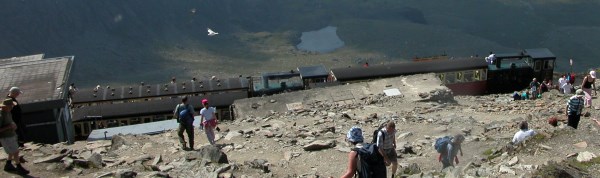
In 2004 it was agreed that the summit buildings would undergo a total refurbishment. Demolition started in the autumn of 2006, with the new centre was originally suppposed to be ready in 2007. There was much debate about the form of the new buildings, and revisions to made sure it is a top class visitor centre which adds to its environment.
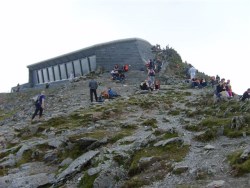
New Summit Cafe - picture Ray Jacob
On the 12th June 2009 the summit building, named Hafod Eryi was officially opened by the First Minister for Wales, the Rt. Hon. Rhodri Morgan AM.
One thing is certain - the cafe at the top of Mount Snowdon will always be a welcome sight to walkers who have struggled their way to the top of the mountain! Although please be aware, if the train is not running all the way to the top due to poor weather, the cafe will be closed.
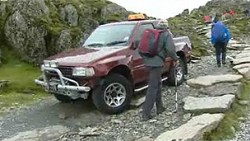
Car on Snowdon
Snowdon's history continues - in 2011 walkers were surprised when they came across a Vauxhall Frontera 4x4 just 400 yards from Snowdon Summit. It was a mystery how it got there for a while but a man was arrested and charged with a motoring offence. Although there had been earlier (unsuccessful attempts) in 1904 and 1917/18, in 1951 Snowdonia became a national park and motor vehicles are banned so this counted as an illegal action. The driver was taken to court.
Other pages you might like:
Walking Up Mount Snowdon
How to get to Snowdon and Where to Stay
Snowdon Facts and History
Snowdon Weather
Walking Equipment
Fitness Required
Holidays in Snowdonia
Mining on Snowdon